
Some thoughts on overdoing it, jealousy, and the grace of having things stripped away

Memory is a grace we must ask for. It is very easy to forget, especially when we are well fed (cf. Dt 6:10-12, 8:11-14) – Pope Francis (pulled from the Magnificat 3/6/24)

At the end of January and into early February, I was riding a total high of endorphins. I had worked my way slowly and carefully back into running and was finding time to get out for 3 mile runs twice a week. It felt amazing. I eased into 4 miles and still felt awesome. I was still doing a lower body strength workout one day, and would do abs after the runs, and was soaking in all the joy of feeling strong and being able to do this thing I loved after so long. Then, I got Joe sleeping through the night and after two nights of uninterrupted sleep, I was out for a run and thought, hey, I want to run a half marathon! I should mention, I had also gotten onto Strava, so I had this social media/dopamine component – when I completed a run I could post it and get “kudos” from friends and family – a feedback loop that made me want to run more and faster and longer, to achieve more goals and feel even more awesome. 

All of this had the very slight feel of being an idol in my life, but was easy to dismiss because it gave me so much joy, it was a fun flow activity, my unicorn space, that spilled over into my vocation as a mom and helped me be a more patient, loving mom. So, I thought I needed it. I deserved it! 

Fast forward to the end of Week 1 of my Half Marathon Training Plan, and I found myself hobbling to finish my 7 mile run, waddling for the rest of day, barely able to walk. The jump in mileage, frequency, and intensity from one week to the next was too much for this 7 month postpartum body to handle and I had strained my groin and adductor tendon as my pelvis had slipped out of alignment. 

I was pretty devastated. It was a crash after such a high, and until I could see a PT and figure out what was wrong, I was stuck, waiting and resting it, not really knowing what “it” was. I started hating Strava. Ugly feelings of jealousy flared up and as I was spiraling I realized how much ego had been wrapped up in this activity. It had been a source of joy, yes, but did I need it? No. 

In this time of feeling stuck and waiting, Lent started. At the 8am Ash Wednesday Mass, with Chris, Joe, and John, I suddenly realized that daily Mass was available to me in a very easy way. Without a workout plan to think about and look forward to, I found myself open to going with Chris, and even without Chris, after dropping off the girls at school. I went, and I went again, and I’ve kept going. I saw the gift God had dropped into my lap, and the grace of hungering for Him, for Him to nourish and sustain me in my disappointment. It’s a brief, sweet window of a few weeks where Joe is still fairly quiet and immobile and happy before his morning nap, and John is pretty good too. I’ve found myself soaking up gratitude for this unexpected grace, and for the words I’ve been resting in – of being His beloved. It’s a time of waiting for our family, also, and I’ve moved from restless anxiety about that, to holding an image of waiting as floating, supported by God’s love and mercy, just floating and waiting. 

I saw the physical therapist yesterday, so my pelvis is back in alignment now, for which I am very grateful. I can start doing strength exercises, stretching, and swimming again. And I’m so happy. I’ll get back to running eventually. But now that I feel well fed, in less pain, I don’t want to forget. The grace of the desert, the grace of waiting. The grace of having my ego stripped away, and feeling a new level of hunger for and dependence on God. My tendency towards comparison and jealousy, and, instead, the hundredfold that Jesus wants to provide for me. 

And a blog post came out of it! Who knew? Prompted by my friend Annie’s suggestion to write it down. ☺️

this looks so bleak now but I snapped it halfway through a run and I was loving it. There’s a Great Blue Heron in the water.

that time I ugly cried at a poetry open mic

I recently had an experience that I think could be described as mystical, in that it felt like a sudden and unexpected outpouring of grace. I’ve been trying to process what happened and why it happened ever since, because although I am very grateful, it was also extremely embarrassing.

On Wednesday night last month, Chris told me that the after-party for the Thursday night prayer service led by the seminarians would be a poetry open mic, and asked if I would want to read one of my poems. I immediately said no. But then, the next day when his classmate texted me asking if I would read a poem if she did, I reconsidered. Two invitations? I decided I would read my villanelle, but I would also read a very good villanelle.

This prayer service is held in the chapel of the seminary on campus, which has the acoustics of a huge bathroom. The seminarian leading the singing doesn’t need a microphone, his voice carries easily. And the response from the pews is thunderous. It is a beautiful time of candle-lit prayer, most of it sung, with a couple short readings and a homily. The last line that closes the evening is the seminarian singing, Let grace come and this world pass away. And the response is, Amen. Come, Lord Jesus. 

This last line, the chorus of voices echoing around me, got me. I had this sudden, deep longing for everything to be made right, a strong desire for Jesus. And the way I experience this kind of longing is through crying. (I’ve mentioned I refer to it somewhat jokingly as having the gift of tears, which is a thing, I just don’t know if I really have it). I teared up but quickly pulled it together because everyone was starting to leave and head downstairs for the open mic part of the evening.

After grabbing tea and scones, Chris and I found seats right in front and sat chatting with his classmates, waiting for the poetry part to begin. I was nervous because as it started, it seemed most people were reciting poems they had memorized, or doing original spoken word poems. I firmly planned to just read the two poems I had brought. Some were funny, some were funny and high energy, and mine were neither. But when it was my turn, I stood up, put on the designated “poetry scarf,” and began.

The first poem went fine. I did a little introduction about villanelles, said I’d be reading a really good one for them first, and read it. Then I turned to mine and felt it deserved a little introduction, too. I think I made the mistake of being rather vulnerable. I shared that this poem was about the Visitation, and that as I was a fairly new convert to Catholicism, I was still getting to know Mary. I like this part of scripture because it shows us Mary from Elizabeth’s perspective, and gives us another glimpse into her life. By this time, my voice had started shaking. I realized that I had just opened up a lot of myself in front of about forty people, most of whom I didn’t know. But I took a deep breath and started reading my poem.

As I was reading, it was the strangest thing, it was like I was surprised by the poem. It’s about two women, two mothers with babies in their wombs, and I suddenly thought, I’m probably the only mother in this room. I read, “Already she faced her share of the sword,” and thought, who am I to be writing this about this woman? By the time I got to the line, “Blessed one! With your yes you moved us toward/the home we long for, and all things made right,” I had totally lost it. I was full on ugly crying in the middle of my own poem.

I garbled out the last two lines, muttered, “Sorry,” and tried to sink as quickly back into my seat as I could. I could not stop crying.

I was so embarrassed and I had no way to explain to all these strangers why I was crying. I wasn’t really sure why either. I tried to dismiss it – it’s just because I’m really tired. But as I tried to block out everyone around me and how ridiculous the situation was, I remembered that God usually does speak to me in deep ways through tears. And this had felt like grace – just much more publicly humiliating and therefore bewildering than I would have chosen.

Two days later I went to a lecture on campus about Chiara Lubich, who founded the lay movement, Focolare. I had no idea who she was but for whatever reason I wanted to go hear this talk. The professor spoke about Chiara’s focus on Maria Desolata  – Mary desolate.

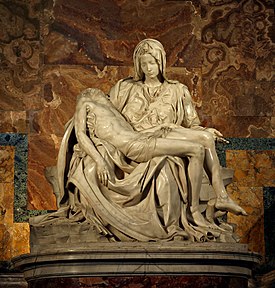
275px-Michelangelo's_Pieta_5450_cropncleaned_edit

He said that Mary, at the foot of the cross, sees all of the misery and suffering of the world, and holds it all. That Maria Desolata was an icon for Chiara for looking unflinchingly and lovingly at a world in pain. Chiara wrote, “If Jesus forsaken seemed to us to be the pupil of God’s eye open onto the world, we can say that Mary desolate seems to us a kind of camera obscura taking in all that is negative in the world (Essential Writings: Spirituality, Dialogue, Culture, p. 299). And the professor commented, “The Mary who holds the disfigured Christ is also the one who can gaze objectively at the world in all of its disfigurement. Just as a photographic image is developed from a negative, Mary can hope for redemption of a fallen world in the midst of her and the world’s most complete agony (“Chiara Lubich: A Saint for a New Global Unity,” Casarella).” 

And I started to cry again. Was that what I had experienced, a tiny glimpse of this? Was that the grace?

Professor Casarella went on to say that Mary desolate also offers “an icon of knowing how to lose.” He summarized Chiara’s thoughts on this, saying, “Apart from her Son, Mary had very little. When she lost him in his Passion, the loss was total and decisive. But she saw this loss for what it really was. The one who prepared all her life to be alone, became Mother to each of us, to the whole of the world (Essential Writings p.302)… Her love, her capacity for giving is human, real, and maternal. It consists of a unique capacity to bear the sorrow of the world in one’s heart. According to Chiara, when a mother hopes all things for her child and puts up with all the troubles involved, she sees further than others. (“Chiara Lubich: A Saint for a New Global Unity,” Casarella). 

I was sitting next to one of Chris’s classmates and when she turned to me at this point to whisper something, she saw that I was crying. She looked concerned and asked,”Are you okay?” I nodded and whispered, “Yeah, I’m fine, I just had this mystical experience the other night and I think it’s making more sense to me right now.” She accepted this as a reasonable explanation (you’re the best, Jackie).

I’m still reflecting on all this and will be for a long time. But in the meantime, St. Therese of Lisieux said, “Everything is grace.” It took ugly crying in front of strangers but now I think I have some idea of what she meant.